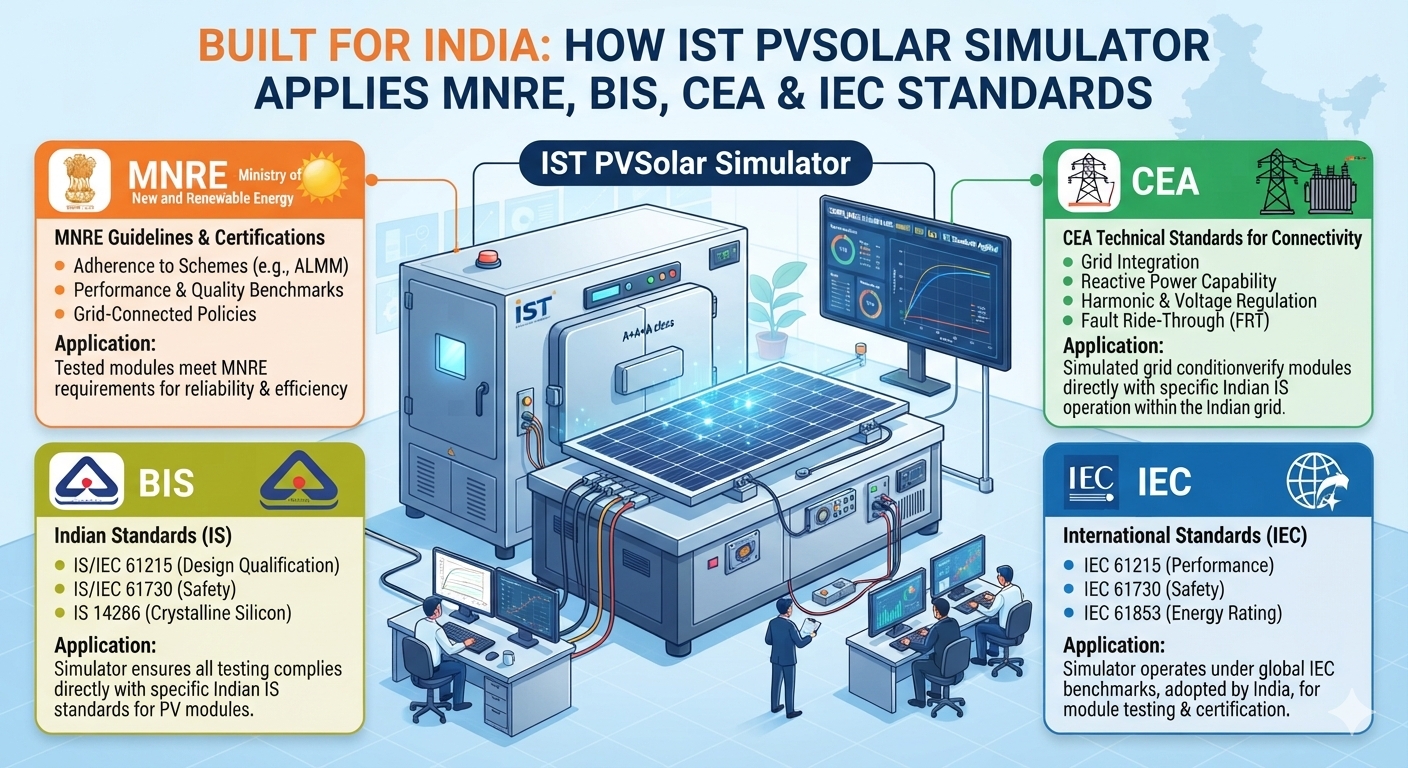
Built for India: How IST PVSolar Simulator Applies MNRE, BIS, CEA and IEC Standards
An Indian solar design is judged against four rulebooks at once: MNRE schemes and lists, BIS product standards, CEA regulations and the IEC standards most BIS codes are built on. IST PVSolar Simulator is built for that reality. When the Country / Market is set to India, the simulator writes these codes into its calculations, schedules, drawings and reports instead of leaving them as an afterthought.
Global simulators model the physics well, but they speak in generic terms like "utility" and "national code". An Indian lender, DISCOM or Electrical Inspector wants to see the DISCOM consumer ID, the CEIG approval, BIS-certified equipment, ALMM-listed modules and earthing designed to IS 3043. This post explains which standard does what, and where IST PVSolar Simulator applies it.
Who sets what
Each body covers a different layer of the project, and the simulator draws on all four.
Body | What it sets | Where the simulator uses it |
|---|---|---|
MNRE (Ministry of New and Renewable Energy) | Approved List of Models and Manufacturers (ALMM), quality control orders, subsidy schemes such as PM Surya Ghar: Muft Bijli Yojana | Equipment databases, residential subsidy slabs in the economics step, DPR policy section |
BIS (Bureau of Indian Standards) | Indian Standards for modules, inverters, cables, earthing and structures, most adopted from IEC | Protection and cable schedule, earthing design, DPR standards table |
CEA (Central Electricity Authority) | Safety and electric supply regulations, grid connectivity standards, CO₂ baseline database | Approvals checklist, grid-code ride-through reference, CO₂ savings |
IEC (International Electrotechnical Commission) | Design, testing and performance-monitoring methods used worldwide | String sizing, energy model, performance ratio and reporting |
The link between BIS and IEC matters. Many BIS solar standards are identical to an IEC standard under dual numbering, so a design that follows the IEC method also follows the Indian Standard. For example, IS 14286 (Part 1/Sec 1):2023 is identical to IEC 61215-1-1:2021, and IS 16221 (Part 2):2015 is identical to IEC 62109-2:2011 (BIS, BIS).
Modules and inverters: BIS, ALMM and IEC
In India, the equipment itself must be certified before the design even starts. Three rules apply.
- BIS certification. MNRE's quality control order makes BIS certification compulsory for solar modules, inverters and storage batteries. Its 2025 update, the Solar Systems, Devices, and Components Goods Order, 2025, replaces the 2017 compulsory registration order (Powerline).
- The Indian Standards behind it. Crystalline modules are type-tested to IS 14286, the Indian version of IEC 61215. Inverter safety follows IS 16221, the Indian version of IEC 62109. Inverter anti-islanding is tested to IS 16169, identical to IEC 62116 (BIS).
- ALMM. Modules must come from ALMM List-I, and from 1 June 2026 cells must come from List-II. This applies to tendered projects and to net-metering and open-access projects commissioned on or after that date, with exemptions for earlier bids and earlier commissioning (Energetica India).
IST PVSolar Simulator puts these rules into the design. Its component databases carry approved models with their certification context, and its Help guide lists the Indian scope it follows: ALMM and QCO for equipment, IEC 61215 and IEC 62548 for the array, IEC 62109 for inverters.
String sizing then checks each string against the inverter. The simulator verifies that the open-circuit voltage at the coldest temperature stays below the inverter's maximum DC voltage, with the IEC 62548 safety margin. It also checks that the MPP voltage stays inside the inverter's MPPT window from the hottest to the coldest day.
Safety, earthing and grid connection
The simulator's Protection & Cable Schedule and earthing card turn the safety codes into numbers a site team can build to.
- Earthing to IS 3043. The number of earth pits, the combined earth resistance and the earthing conductor size are calculated from soil resistivity and fault current using the IS 3043 method. The results go straight into the schedule and the bill of quantities.
- Lightning protection. Early streamer emission air terminals are sized to NF C 17-102:2011. Where a contract calls for IS/IEC 62305, the Help guide tells the designer to use its rolling-sphere or mesh method instead.
- Surge protection and cables. DC surge protectors are chosen to IEC 61643-31 from the string's cold-weather open-circuit voltage, and AC surge protectors to IEC 61643-11. Cables are sized for at least 1.25 times the module short-circuit current on the DC side and full-load current on the AC side, with IEC 60364-7-712 practice and Indian cable standards.
- Grid connection. For India the grid-code reference is set to CEA / IEGC, with an indicative low- and high-voltage ride-through table and a field to record the inverter's certification. The approvals checklist includes the Electrical Inspectorate (CEIG) drawing approval and the DISCOM net-metering steps.
Two CEA regulations sit behind this work. The CEA (Measures relating to Safety and Electric Supply) Regulations, 2023 came into force on 8 June 2023 and superseded the 2010 version (TeamLease RegTech). The CEA Technical Standards for Connectivity of Distributed Generation Resources govern rooftop and other generators connecting below 33 kV. A 2018 draft amendment proposed harmonic limits to IEEE 519-2014 and a cap on DC injection of 0.5% of rated output (Mercom); designers should check the notified text for their project.
Performance, economics and reports
The energy model follows IEC methods, so its results read the same way a lender's engineer would check them. The simulator lists IEC 61724-1:2021 for performance monitoring and performance ratio, IEC 61724-3 for energy assessment and uncertainty, and IEC 61853-1 to -4 for module performance across irradiance and temperature.
The Indian context runs through the economics:
- CO₂ savings use the CEA grid emission factor of about 0.82 kg CO₂/kWh, from the CEA CO₂ Baseline Database.
- Subsidies for homes follow the PM Surya Ghar: Muft Bijli Yojana slabs.
- Net metering assumes exports offset the bill at the retail tariff, as in most states, with any annual surplus paid at a low average purchase rate. Gross metering can be chosen instead with the state feed-in tariff.
- Tax uses GST per item, and an indicative corporate-tax preset with 40% written-down-value depreciation for solar plant.
The Detailed Project Report brings it together. Its standards table lists IEC 62548 and IEC 61215/61730 for the array; IEC 62109, IEC 61727 and the CEA connectivity regulations for inverters and grid; IS 7098 and IEC 62930 for cables; IS 1180 / IEC 60076 for transformers; IS 3043 and IEC 62305 for earthing and lightning; IS 875, IS 800 and IS 2062 for structures; and IEC 62446-1 and IEC 61724-1 for testing. With AI sections switched on, section 3.1 on national and state renewable-energy policy is written from a live web search, so MNRE schemes and DISCOM rules are current when the report is made.
What the designer still confirms
A simulator can carry the standards; it cannot sign for them. Before a design goes to a DISCOM, the Electrical Inspectorate or a lender, confirm:
- every module and inverter model is BIS-certified and on the current ALMM lists for the project's commissioning date
- the state's current net-metering or gross-metering regulation and the DISCOM's technical requirements
- soil resistivity and earth resistance by site test, since the earthing design depends on them
- the latest edition of each standard named in the contract
IST PVSolar Simulator's aim is simple: an Indian design should read as Indian from the first string check to the last page of the DPR. MNRE, BIS, CEA and IEC each cover one layer of a project, and the simulator brings them together in one place.
Sources
- BIS — IS 14286 (Part 1/Sec 1):2023
- BIS — IS 16221 (Part 1):2016
- BIS — IS 16221 (Part 2):2015
- BIS — IS 16169:2019 test report format
- Powerline — MNRE notifies updated quality control order for solar PV products
- Energetica India — ALMM List-II for solar PV cells effective from 1 June 2026
- TeamLease RegTech — CEA (Measures relating to Safety and Electric Supply) Regulations, 2023
- Mercom — CEA regulations for connectivity of rooftop solar