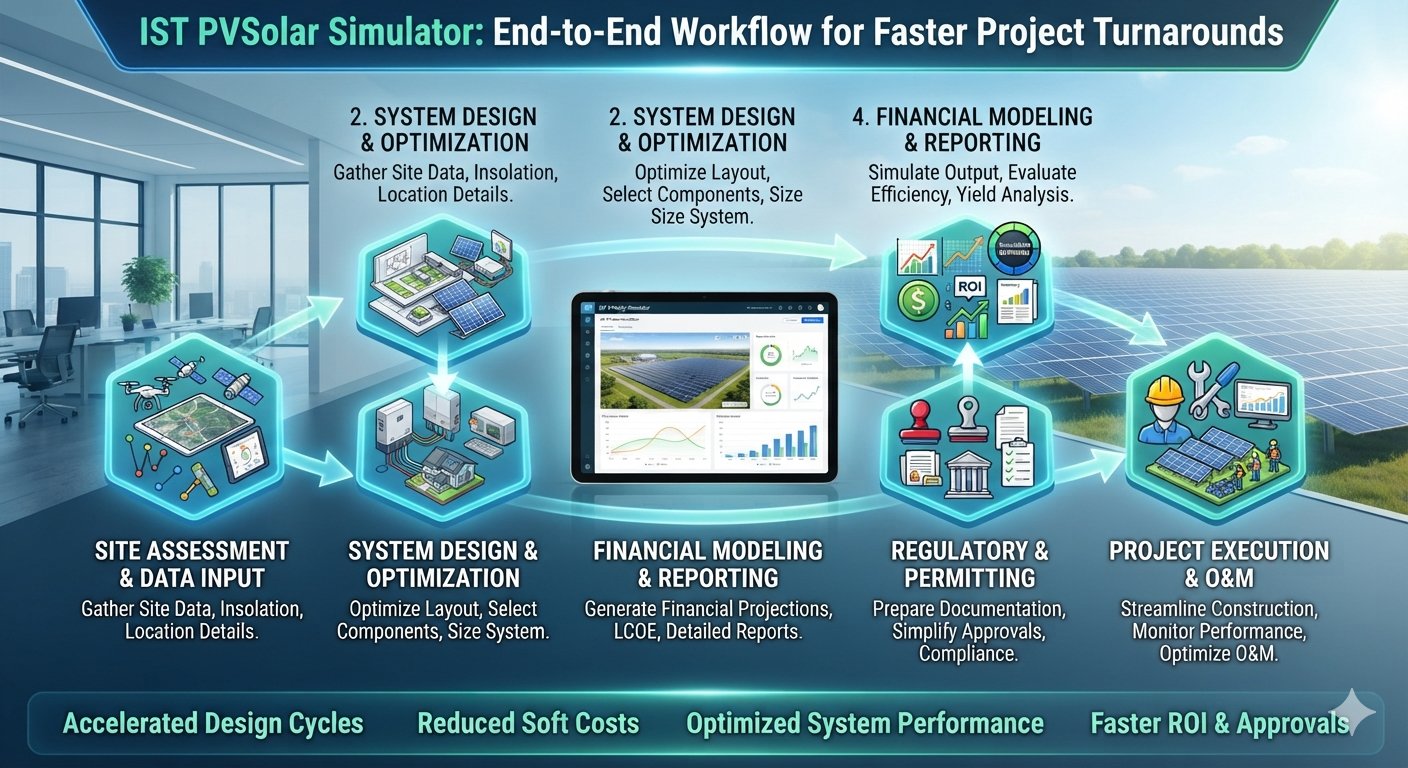
IST PVSolar Simulator's End-to-End Workflow for Faster Project Turnarounds
The gap between winning a solar lead and delivering a signed, bankable proposal is where most project turnaround time actually disappears — not in any single calculation, but in the handoffs between disconnected tools and the manual re-entry that bridges them. IST PVSolar Simulator closes that gap by running site assessment, system design, financial modeling, and proposal generation through one connected workflow, so a project moves from first site data to client-ready documentation without leaving the platform.
Where Turnaround Time Actually Gets Lost
Ask any solar engineering team where project delivery slows down, and it's rarely the core simulation math. It's everything around it: re-entering the same project details into a separate financial tool, manually transcribing equipment specs from a datasheet, redrawing a wiring diagram after a design change, rebuilding a proposal document from scratch because the last one doesn't quite match this project's numbers. None of that is engineering — it's overhead, and overhead is what determines how fast a project actually moves from lead to contract.
Site to System: Automated From the Start
A project begins with location and resource data, and the platform removes the manual steps that used to precede any real design work. Latitude and longitude auto-populate city, state, country, and altitude. One click imports NASA Hourly TMY or PVGIS TMY or manual weather data import — real measured-derived solar resource, not a manually downloaded and reformatted file.
Module and inverter specifications can be extracted directly from a manufacturer's datasheet PDF via AI curve digitization, instead of an engineer manually transcribing I-V curve points for every new piece of equipment evaluated.
Design Validated as You Build It
Every sub-array configuration — modules per string, strings per MPPT, inverters per array — gets checked live against real electrical limits: Voc at minimum winter temperature, Vmp across both temperature extremes, current against per-MPPT and inverter maximums, computed from single-diode I-V modeling rather than linear approximation. Catching a mis-sized string here, before the design is finalized, is what prevents a turnaround delay later — a field problem discovered after installation costs far more time than a validation check catches in seconds during design.
One Simulation, Every Downstream Number
This is the structural piece that actually compresses turnaround time the most: the hourly or sub-hourly simulation run in Tab 7 is the single source every other output reads from. The loss table, the financial model (NPV, IRR, LCOE, DSCR), the bankability assessment, the single line diagram, and the final report all pull from that same simulation — not five independently calculated numbers that need to be manually reconciled before a report goes out. Change a design input, and every downstream figure updates from the same source, with no step where someone has to remember to re-enter a number somewhere else.
From Design to Document Without a Manual Handoff
Once the design is validated, the platform generates what actually needs to reach a client or a lender:
- A standards-compliant design report (IEC 61724-1, IEC 61853, BIS IS 16169, CEA, MNRE) built directly from the simulation output.
- A bankability assessment scoring module, inverter, EPC contract terms, and financial covenants against real lender benchmarks — with the specific threshold each risk flag failed against stated explicitly.
- Single line diagrams and wiring schedules generated from the actual validated electrical solution, with cable sizing and voltage drop already checked.
- A full EPC proposal — cover letter, CAPEX/BOQ, project schedule, financial summary, terms and conditions — built from data already in the project, with reusable company and customer profiles so recurring details don't get re-typed on every quote.
That last step is usually the one that determines whether a proposal goes out this week or next month. Generating it directly from validated project data, rather than assembling it by hand afterward, is what turns "design is done" into "proposal is out the door" without a multi-day gap in between.
Why the Turnaround Gain Compounds
None of these individual steps look dramatic on their own — a faster weather import here, a validated string check there. The gain compounds because every manual step removed from one project is a manual step removed from every project after it. A design-to-proposal cycle that used to take days, spread across separate tools for shading, financial modeling, and document assembly, becomes a single continuous workflow inside one platform — not because any one calculation got faster, but because the handoffs between calculations disappeared.
Conclusion
Faster project turnaround isn't about rushing the engineering — it's about removing the manual reconciliation that used to sit between validated design and a document someone can actually sign. By running site assessment, electrical validation, financial modeling, and proposal generation from one simulation that feeds every downstream output, IST PVSolar Simulator keeps that entire path connected — so the time a project spends between "we have a site" and "we have a proposal ready to send" is determined by the engineering decisions that matter, not the overhead of moving data between disconnected tools.