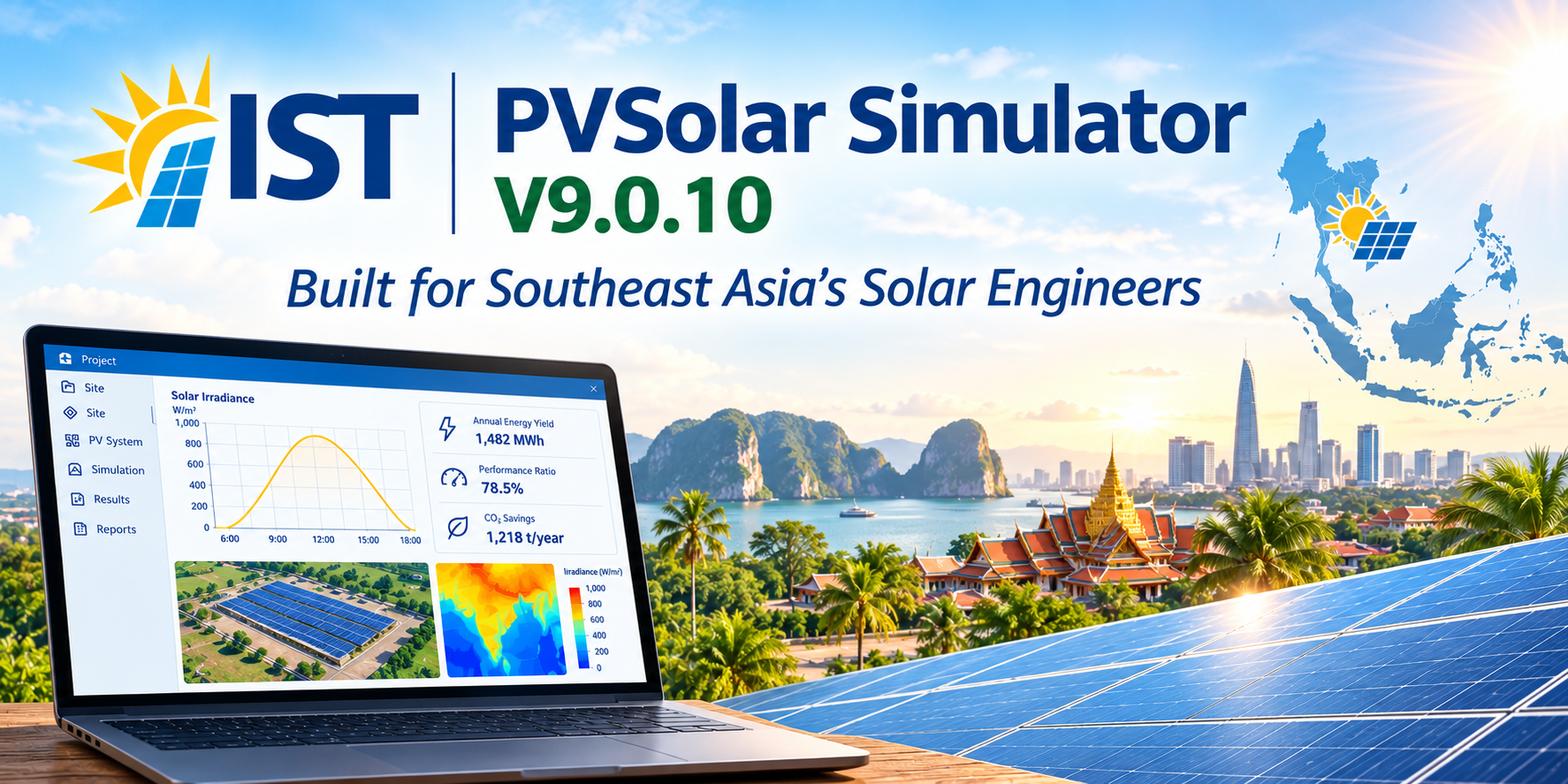
IST PVSolar Simulator V9.0.10 takes a Southeast Asian solar project from site data to a bank-ready report in one platform. It uses the utilities, rooftop schemes, currencies and tropical conditions that projects in the region actually face.
Why Southeast Asia needs its own solar platform
Southeast Asia's rooftop market runs on rules that change fast and differ sharply by country. A factory roof in Selangor, a warehouse in Bangkok and an industrial site in Java each sit under a different utility, a different quota system and a different export rule.
In several markets exports earn little or nothing, so the business case depends on self-consumption, not on feed-in. Tropical heat raises cell temperatures. Monsoon rain, haze seasons and humidity shape soiling and lightning risk.
Most PV tools assume European net metering and a temperate climate. Engineers then patch the gaps in spreadsheets. IST PVSolar Simulator builds the local rules in, so the selected country drives the standards on drawings, the utility in approvals, the tariff in local currency and the tax treatment in the financial model.
Native to Southeast Asian utility frameworks
The simulator covers 11 Southeast Asian countries. Malaysia, Thailand, Indonesia and Cambodia have full local profiles. Brunei, Laos, Myanmar, the Philippines, Singapore, Timor-Leste and Vietnam use a Southeast Asia regional profile with their own currency, VAT or GST rate and grid CO₂ factor.
Market | Utility and approvals on drawings | Default export credit | Tax and depreciation preset |
|---|---|---|---|
Malaysia | TNB connection assessment and Solar ATAP registration through a SEDA-registered PV service provider; ST competent-person sign-off | Solar ATAP (from 1 Jan 2026): exports offset consumption for 10 years, then self-consumption only | 24% tax; capital allowance 34% in year 1, then 14% a year |
Thailand | MEA / PEA parallel-connection approval; ERC notification or licence exemption | Households up to 10 kWp: 2.20 THB/kWh for up to 10 years; C&I: self-consumption | 20% tax; 5% straight line; BOI exemption entered as a tax holiday |
Indonesia | PLN rooftop application within the published quota, and SLO certification | Self-consumption only (MEMR Regulation 2/2024) | 22% tax; Group 4, 5% straight line (PMK 72/2023) |
Cambodia | EAC rooftop registration and EDC connection approval | Self-consumption; a capacity charge may apply above 10 kW | 20% tax; 20% declining balance |
7 other countries | Utility / regulator grid-connection approval | Local net-metering / export rules | Enter local rates |
The full profiles also carry local codes and product marks onto drawings and reports. Examples are MS IEC 60364 and SIRIM certification in Malaysia, the EIT installation standard and TIS marks in Thailand, and PUIL 2011 and SNI in Indonesia.
All values are indicative starting points and stay editable. The administrator can update a country centrally when a scheme changes. Each user can also save their own values for their market in the Database tab, and the simulator then uses them in place of the built-in ones.
From site data to a bankable energy yield
The simulation engine runs at monthly, hourly (8,760 steps) or 15-minute sub-hourly (35,040 steps) resolution. The hourly and sub-hourly runs are the ones meant for bankable reports.
Solar resource. Import a NASA POWER hourly TMY or a PVGIS TMY built to ISO 15927-4, or enter the 12-month table by hand. Loading a measured hourly TMY automatically tightens the resource uncertainty from ±5% to ±2.5%.
Physics chain. Each hourly step follows the same sequence:
- Perez (1990) anisotropic transposition converts horizontal irradiance to plane-of-array irradiance. This matters under the diffuse-heavy skies of the wet season.
- Martin–Ruiz incidence-angle losses and an air-mass spectral correction give the effective irradiance.
- The Faiman model sets cell temperature from irradiance, air temperature and wind, so tropical heat losses are calculated, not assumed. A single-diode (De Soto 5-parameter) model then gives module power.
- DC losses and degradation are applied, then the inverter efficiency curve and true AC clipping.
- Local climate built in. Each market profile carries its own seasonal soiling and climate notes into the reports, so the cleaning plan and the soiling loss you choose match the site. Malaysia's covers the north-east monsoon (November–March) and the haze season (June–September). Thailand's covers dry-season dust and northern haze. Indonesia's covers heavy wet-season rain and volcanic ash in some regions.
- Shading in 3D. Dense industrial estates and urban rooftops mean neighbouring buildings, parapets and services shade the array. Upload a drone orthomosaic (JPG, PNG or GeoTIFF, with optional KML, GeoJSON or LAS point-cloud files). Trace obstructions and lay out real panels to get an hourly shading profile instead of a flat percentage.
- Bifacial and trackers. An unlimited-sheds view-factor model calculates rear-side irradiance from albedo, mounting height and pitch. Single-axis trackers with backtracking are supported for ground-mount plants.
- No .PAN or .OND files needed. Build any module or inverter model straight from the manufacturer's PDF datasheet. Many suppliers serving the region do not publish proprietary simulation files.
Electrical design and self-consumption storage
Once the simulation runs, the electrical package is built from the same design data. There is nothing to retype, and the drawings always match the yield model.
Deliverable | What it produces | Basis |
|---|---|---|
Protection & Cable Schedule | Cable sizes, gPV string fuses, protection ratings and voltage-drop checks against your actual cable route lengths | IEC 60364-7-712 and IEC 60269-6, with the market's wiring rules: Electricity Regulations 1994 and MS IEC 60364 in Malaysia, the EIT standard in Thailand, PUIL 2011 in Indonesia |
Wiring Diagram | Every string routed through the DCDB, MPPT and inverter, with an MPPT string schedule; mirrors the real 3D layout when one exists | Matches the Total System Summary exactly |
Earthing & lightning protection | Electrode resistance, number of earth pits, conductor size, and ESE air-terminal count and mast height | Earthing formulas plus NF C 17-102:2011, important where tropical thunderstorms are frequent |
EPC Proposal & BOQ | Client-facing proposal and bill of quantities | Pulled live from the design and financials |
Draft DPR | Lender-style Detailed Project Report in Word: 19 chapters and Annexures A–L, with the SLD, loss diagram and charts embedded | Policy chapter can be drafted from a live web search for the project's country |
Storage sized for self-consumption. Where exports earn little or nothing, as in Indonesia, Cambodia and Thai C&I, every kilowatt-hour used on site counts. The storage study shows how much:
- Dispatch: an hourly simulation of PV, load and battery over the full year, using an imported 8,760-hour load profile or a day/night appliance tally
- Self-consumption: the share of solar used directly, stored and exported, with and without the battery
- Bill savings: time-of-day rates, demand charges per kVA, peak shaving with a suggested import cap, and DC coupling that stores energy the inverter would otherwise clip
- Chemistry and life: LFP, NMC and lead-acid options with typical efficiency, cycle-life, replacement and running-cost defaults
Bankability that regional lenders recognise
The financial model runs on the conservative P90 energy, not the P50 headline. Every ratio is tested against covenant thresholds the lender sets.
The path from yield to investment decision:
- Uncertainty. Four sources are combined by root-sum-square: inter-annual variability (±5%), resource data (±5%, or ±2.5% with a measured TMY), model (±1.5%) and components (±2%). The result is P50, P75, P90 and P95 yields.
- Project-level model. LCOE, NPV, IRR, ROI, profitability index, simple and discounted payback, and break-even tariff, with a year-by-year cash flow in local currency.
- Equity-level model. Project IRR, equity IRR, minimum DSCR over the loan tenure, and a CAPEX/Wp check against country-specific benchmark bands.
- Monte Carlo risk. 20,000 trials by default across the 8,760-hour AC series, degradation, and tariff and OPEX escalation. It reports P10, P50 and P90 ranges for NPV, equity IRR, LCOE and DSCR.
- Risk score and report. A 0–100 composite from Investment Grade to Speculative, with a hard override if NPV or DSCR fails. A lender-facing Bankability Assessment Report records the preparer, the reviewer and the grade of the resource data, and covers country risk and currency/FX mismatch.
- Export rules follow project type, size and time. In Thailand, a household system up to 10 kWp is credited at 2.20 THB/kWh for 10 years, while a C&I system is valued on self-consumption alone. In Malaysia, Solar ATAP's energy offset lasts 10 years, after which the model switches the project to self-consumption.
- Tax presets in one click. Apply the country preset and the model sets the corporate tax rate and depreciation schedule. Malaysia's capital allowance runs 34% in year 1, then 14% a year. Indonesia's uses the PMK 72/2023 Group 4 straight-line rate.
- Incentives entered directly. Thailand's BOI corporate-tax exemption of up to 8 years and Cambodia's QIP tax holiday are entered as a Tax Holiday, so their effect shows in every year's cash flow.
Who it is for, and how to start
The platform serves everyone who touches a Southeast Asian solar project between concept and financial close:
- C&I rooftop EPC contractors building self-consumption systems for factories, warehouses and malls, who need a utility-ready design, storage study and client proposal in one place
- Utility-scale and solar-farm developers sizing ground-mount and tracker plants with 3D terrain, row pitch and true inverter clipping
- Technical advisers and due-diligence engineers who need P90 yields, transparent loss chains and a reproducible report
- Banks, green-finance lenders and investors reviewing DSCR, equity IRR, country risk and the risk score against their own covenants
- Universities and researchers, through the Research tab: IEC 61724-1 accounting, sensitivity analysis, uncertainty, and SCADA benchmarking against measured plant data
- Start on the Free Plan. Every new member is activated on the Free Plan automatically at sign-up. It covers project setup, orientation, module and inverter selection, sub-array design and the full simulation engine. Reports carry a DEMO VERSION watermark.
- Upgrade when the project needs it. Paid plans unlock 3D Shadow Analysis, Economic Evaluation and Bankability, the component databases, and EPC Proposals and BOQ. The Research tab comes with the higher tiers. If a paid plan lapses, the account returns to the Free Plan automatically.
One design, one source of truth
IST PVSolar Simulator V9.0.10 replaces the chain of separate tools and spreadsheets behind a Southeast Asian solar project. One design drives a P90 yield, a code-compliant electrical package, a self-consumption storage study and a lender-ready bankability report.
Because each market profile carries its real rules, the numbers start close to correct. That covers Solar ATAP in Malaysia, MEA/PEA buyback in Thailand, PLN quotas in Indonesia and EAC rules in Cambodia. Engineers spend their time on the design, not on re-keying data.
Create a free account at istpvsolarsimulator.com and run your first 8,760-hour simulation today.
Tariffs, tax rates, exchange rates and policy rules in the simulator are indicative starting points. Confirm the current values with your utility, regulator and a tax adviser before issuing a bankable report.