Abstract
This article undertakes a comparative capability
study of solar software platforms — the IST PVSolar Simulator V9.0.0 — against three specific
project deliverables: the energy-yield Simulation Report, the DC & AC Cable
Route Diagram report, and the Bankability Assessment Report. Based on different platform's own documentation,
technical publications and independent reviews, the study finds that no single
platform natively delivers all three deliverables to independent-engineer,
lender-grade depth. Some software provide detailed energy simulation and deep financial modeling respectively, but
neither produces a physical cable-routing deliverable, some provider design-and-sales-proposal tier that increasingly
includes automated single-line-diagram (SLD) generation but with region- or
tier-dependent coverage and generally simplified financial-risk output, sits closer to the detailed-simulation tier with
strong 3-D visualization but a market focus historically weighted toward
residential and commercial systems. The IST PVSolar Simulator
V9.0.0 is found to be one of a small number of platforms that natively combines all three report types
in a single tool — a rigorous hourly/sub-hourly Simulation Report, a Protection
& Cable Schedule with a generated single-line diagram and
voltage-drop-based cable sizing, and a vectorised Monte-Carlo Bankability
Assessment Report — though the paper is explicit that this cable-route
capability is a schematic, length-input-driven schedule rather than a
geo-referenced trench-routing drawing, a distinction that matters for how each
report should be used in practice.
1. Introduction
The solar software market has fragmented into distinct tiers serving different stages of project development: resource pre-screening tools used before a site is committed to; detailed physics-based simulation engines used to produce the energy-yield figure a project's economics rest on; design-and-sales platforms optimised for rapid proposal turnaround in the residential and commercial-and-industrial (C&I) segments; and dedicated financial-modeling engines used to translate an energy estimate into project-finance metrics. A recurring source of confusion in practice is that marketing materials across this market often use similar language ("bankable", "investor-grade", "lender-accepted") regardless of which of these tiers a given platform actually occupies. This article addresses that confusion directly by comparing eleven named platforms against three specific, concretely-defined project deliverables — the Simulation Report, the DC & AC Cable Route Diagram report, and the Bankability Assessment Report — based on other platform's own documentation and independent technical reviews, continuing the platform-characterization work of this article series.2. Methodology
For the IST PVSolar Simulator V9.0.0, capability claims in this paper are grounded directly in a review of the platform's own source code and in-application documentation, consistent with the companion papers in this series. For the ten external platforms, capability claims are drawn from each vendor's own product documentation, help-center articles and feature pages, supplemented where available by independent technical validation studies and by independent third-party review sources. Where a claim rests on marketing language that could not be independently verified against a technical specification, this is stated explicitly rather than presented as confirmed fact.
3. The Three Report Types Defined
3.1 Simulation Report
An energy-yield Simulation Report models expected AC energy production from solar resource, system design and loss assumptions, typically at hourly or sub-hourly resolution for a bankable-grade deliverable, and includes a documented loss waterfall from reference irradiance to net delivered energy.
3.2 DC & AC Cable Route Diagram Report
A DC & AC Cable Route Diagram report documents the electrical interconnection of a PV plant from module strings through combiner/DC boxes, inverters, AC distribution and (for utility-scale plants) step-up transformers and switchgear, typically as a single-line diagram (SLD) accompanied by cable sizing and protection-device ratings derived from actual route lengths and a voltage-drop calculation, per standards such as IEC 60364-7-712.
3.3 Bankability Assessment Report
A Bankability Assessment Report translates the energy-yield forecast into project-finance metrics — typically NPV, IRR, LCOE and DSCR — under one or more probability (P50/P90 or finer) scenarios, to a standard of documentation and traceability that an independent engineer or lender's technical adviser can rely on for a financing decision.
4. Capability Review
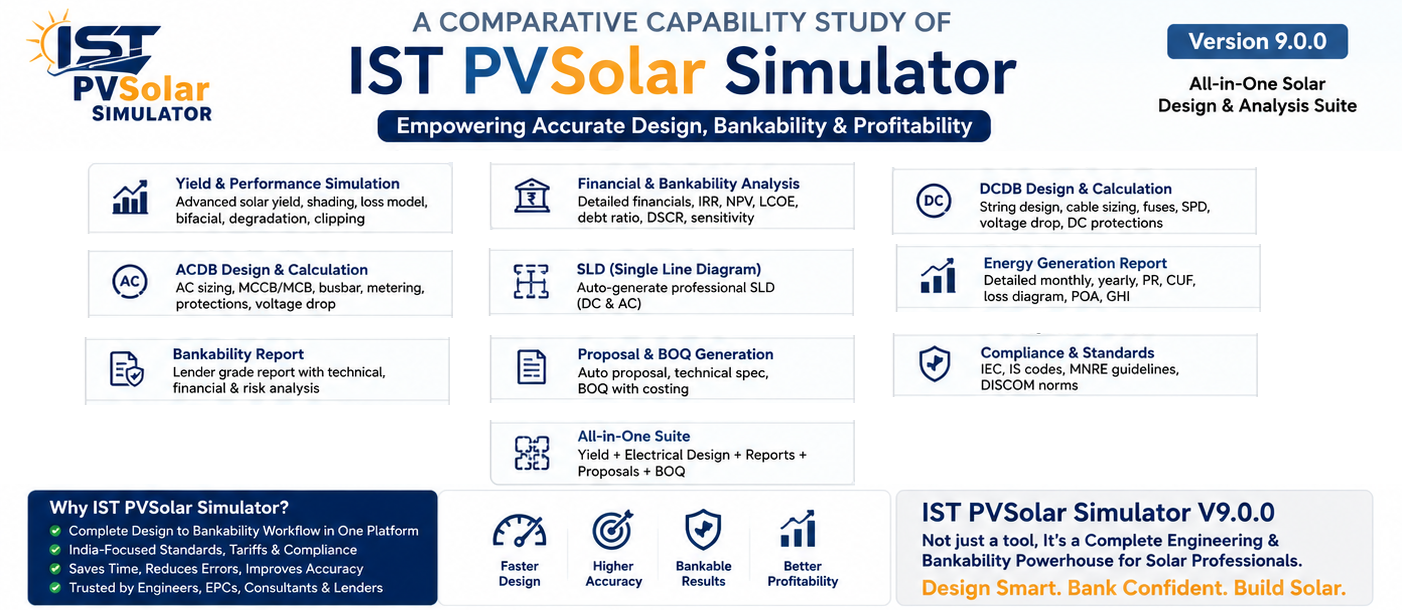
IST PVSolar Simulator V9.0.0 — An integrated platform combining an hourly/sub-hourly physics-based Simulation Report (Perez transposition, single-/two-diode electrical model, Faiman thermal model, infinite-sheds bifacial modelling), a native Protection & Cable Schedule module that computes cable sizing and protection ratings from user-entered route lengths (string, string-to-DCDB, DCDB-to-inverter, inverter-to-ACDB, LV-busbar-to-transformer, transformer-to-33kV-switchgear) per IEC 60364-7-712 and IEC 60269-6, exportable with a generated single-line diagram, and a Monte-Carlo Bankability Assessment Report (NPV, equity IRR, LCOE, DSCR).
Conclusion
The IST PVSolar Simulator V9.0.0 is one of a small number of platforms that natively combines meaningful capability across all three report types, with a rigorous physics-based Simulation Report, a Protection & Cable Schedule with generated single-line diagram, and a Monte-Carlo Bankability Assessment Report — though its cable-route output remains a schematic, length-input-driven schedule rather than a full geo-referenced trench-routing deliverable, and this distinction, along with the broader tiered structure documented in this paper, should inform how any of the eleven platforms reviewed here is selected for a specific project deliverable.
References
[1] PVsyst SA. PVsyst 7/8 software documentation and help files, pvsyst.com.
[2] National Renewable Energy Laboratory. System Advisor Model (SAM) General Description, docs.nrel.gov/docs/fy14osti/61019.pdf.
[3] National Renewable Energy Laboratory (2019). Validation of Photovoltaic Modeling Tool HelioScope Against Measured Data. docs.nrel.gov/docs/fy19osti/72155.pdf.
[4] Folsom Labs / Aurora Solar. HelioScope product documentation and feature listings, helioscope.aurorasolar.com.
[5] European Commission Joint Research Centre. PVGIS (Photovoltaic Geographical Information System), re.jrc.ec.europa.eu/pvg_tools.
[6] Valentin Software GmbH. PV*SOL premium product documentation, valentin-software.com.
[7] SurgePV. Product documentation and feature pages, surgepv.com.