Solar design, now in your language
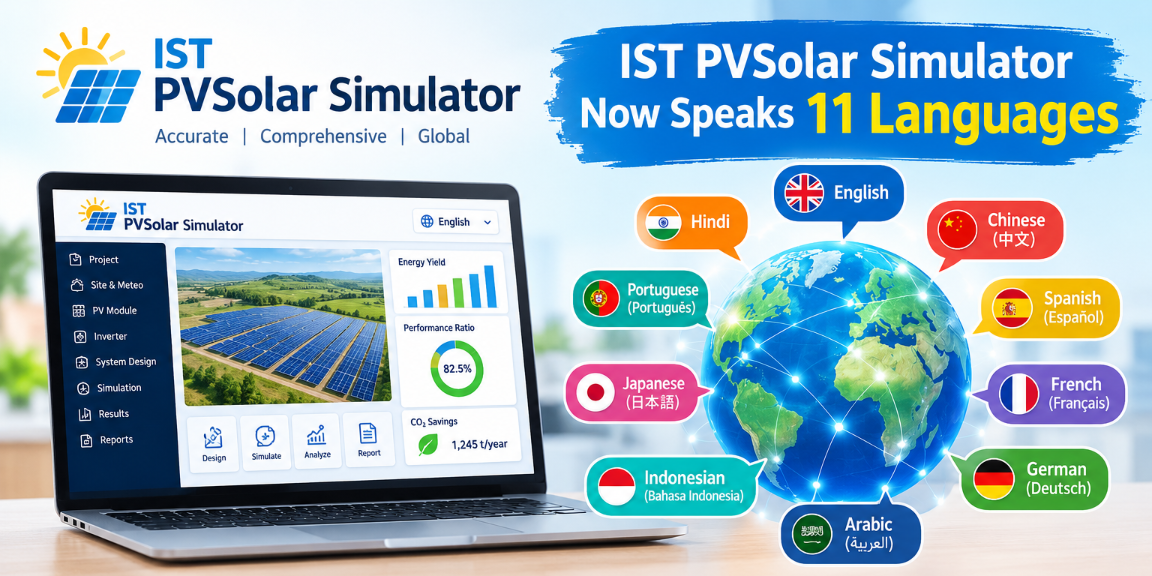
IST PVSolar Simulator now runs in 11 screen languages, so engineers from Delhi to Dakar can design solar plants in the language they think in.
Solar is growing fastest in South Asia, Africa, the Middle East and Latin America. Many of the engineers, installers and students doing that work learned their trade in Hindi, Bangla, Tamil, Arabic, Swahili, Hausa, Amharic, French, Spanish or Portuguese. Until now, they had to read every menu, tooltip and warning in English.
The new language menu changes that. Pick a language and the menus, tabs, buttons, labels and help tips switch at once, on the same page, with no reload. The physics stays the same: every simulation gives identical results in every language.
What you hand to a bank, a utility or a regulator does not change. Reports, DPR drafts, proposals, CSV exports and .pro project files stay in English, the common language of solar finance and standards.
Eleven languages, one simulator
Each language was chosen for the regions where solar is being built and where engineers most need tools in their own language. English remains the main language and the fallback for any text not yet translated.
Language | Script | Main countries and regions | Why it matters for solar |
|---|---|---|---|
English | Latin | Worldwide; India, Nigeria, Kenya, the Philippines, the UK, the USA, Australia | The working language of IEC standards, lenders and EPC contracts. All reports and project files stay in English. |
हिन्दी (Hindi) | Devanagari | India (north and central states), Nepal, Fiji, Mauritius | Rooftop and PM Surya Ghar installers across India's Hindi belt can learn and quote in their first language. |
বাংলা (Bangla) | Bengali | Bangladesh; India (West Bengal, Tripura, Assam) | Serves Bangladesh's rooftop and industrial solar sector and eastern India's growing installer base. |
தமிழ் (Tamil) | Tamil | India (Tamil Nadu, Puducherry), Sri Lanka, Singapore, Malaysia | Tamil Nadu is one of India's leading solar states, with a large community of design engineers and technicians. |
Español (Spanish) | Latin | Spain, Mexico, Chile, Colombia, Argentina, Peru and the rest of Latin America | Opens the tool to some of the world's sunniest markets, from the Atacama to the Iberian Peninsula. |
Français (French) | Latin | France, Belgium, Canada (Québec); Morocco, Tunisia, Algeria; Senegal, Côte d'Ivoire, Mali, Burkina Faso, Cameroon, DR Congo | Reaches French-speaking West and Central Africa, where mini-grids and solar irrigation are expanding fast. |
Português (Portuguese) | Latin | Brazil, Portugal, Mozambique, Angola, Cabo Verde | Supports Brazil's large distributed-generation market and Lusophone Africa. |
العربية (Arabic) | Arabic, right-to-left | Saudi Arabia, the UAE, Oman, Qatar, Egypt, Jordan, Iraq, Morocco | The full interface flips to right-to-left reading, while numbers, units and input fields stay left-to-right. |
Kiswahili (Swahili) | Latin | Tanzania, Kenya, Uganda, Rwanda, eastern DR Congo | The shared language of East Africa's off-grid, pay-as-you-go and productive-use solar sector. |
Hausa | Latin | Northern Nigeria, Niger, Ghana, Cameroon, Chad | One of West Africa's most widely spoken languages, serving Nigeria's fast-growing solar mini-grid market. |
አማርኛ (Amharic) | Ge'ez (Ethiopic) | Ethiopia | Displayed in Noto Sans Ethiopic for clear, correct characters on any device. |
Languages and countries at a glance
- English: worldwide, including India, Nigeria, Kenya, the Philippines, the UK, the USA and Australia
- हिन्दी (Hindi): India (northern and central states), Nepal, Fiji, Mauritius
- বাংলা (Bangla): Bangladesh; India (West Bengal, Tripura, Assam)
- தமிழ் (Tamil): India (Tamil Nadu, Puducherry), Sri Lanka, Singapore, Malaysia
- Español (Spanish): Spain, Mexico, Chile, Colombia, Argentina, Peru and the rest of Latin America
- Français (French): France, Belgium, Canada (Québec); Morocco, Tunisia, Algeria; Senegal, Côte d'Ivoire, Mali, Burkina Faso, Cameroon, DR Congo
- Português (Portuguese): Brazil, Portugal, Mozambique, Angola, Cabo Verde
- العربية (Arabic): Saudi Arabia, UAE, Oman, Qatar, Egypt, Jordan, Iraq, Morocco
- Kiswahili (Swahili): Tanzania, Kenya, Uganda, Rwanda, eastern DR Congo
- Hausa: Northern Nigeria, Niger, Ghana, Cameroon, Chad
- አማርኛ (Amharic): Ethiopia
How it works
The screen speaks your language; the data and the deliverables stay in English, so every project file can be shared, audited and financed anywhere.
- One click, same page. Choose a language from the menu bar. Menus, tabs, buttons, field labels and tooltips switch instantly, including the Economics Evaluation and Run Simulation screens. Your choice is remembered for the next visit.
- Right-to-left for Arabic. The layout mirrors for natural Arabic reading. Number fields, tables, charts and diagrams stay left-to-right, so values such as 4.989 ₹/kWh read correctly.
- English-only inputs. Project names, client details and other typed fields accept English only. If text in another script is typed, a warning appears in the user's chosen language and the field keeps English. This keeps project files, reports and bank submissions readable by every reviewer.
- English deliverables. Simulation reports, bankability reports, DPR drafts, EPC proposals, CSV and hourly exports, CAPEX templates and .pro project files are always produced in English, even when the screen is in another language.
- Same results in every language. Translation touches only the words on screen. Energy yield, performance ratio, LCOE and NPV are identical whichever language is selected.
- Help page translator. The Help & User Guide now has its own language menu. It translates the whole guide in place using Google's free website translator, with no separate page per language. Code, formulas and standard numbers such as IEC 61724-1 are kept in English, and a notice reminds readers that the English text is the reference.
Who benefits
- EPC companies and installers: train field teams faster and cut design errors caused by misread English labels.
- Engineering colleges and ITIs: teach PV design in the language students learn best.
- Developers and consultants in emerging markets: work in the local language with local partners, then send English reports to lenders.
- Utilities, agencies and DISCOMs: review designs locally while keeping a single English record for approvals.
Frequently asked questions
- Do simulation results change with the language? No. Only the screen text changes; every calculation is identical.
- Why are reports and project files only in English? Banks, utilities, auditors and IEC-based reviews work in English. One language for deliverables means any project can be checked anywhere without retranslation.
- Can I type project details in my own language? No. Inputs are English-only to keep files and reports consistent. The simulator shows a warning in your chosen language if another script is typed.
- Is the Help guide translated? Yes, through the built-in a machine translation, so the English text is the reference for technical terms.
- Can I switch back to English? Yes, at any time from the same menu. English is also shown for any text not yet translated.
Try it in your language
Open IST PVSolar Simulator, choose your language from the menu bar and run your next project in the language you think in. Your bank-ready report will still come out in English.