What Sets IST PVSolar Simulator Apart: Built-In, Not Bolted On
Most solar design software is built for a global, generic audience and then patched with regional add-ons later — a plugin here, an exported spreadsheet there, a separate compliance checklist run by hand. IST PVSolar Simulator was built the other way around: as one connected platform where the calculation engine, Indian regulatory compliance, and bankability reporting were designed together from the start, not stitched on afterward.
That "designed together, not bolted on" difference is where its most distinctive capabilities live. Here's what that looks like across four areas.
1. An integrated calculation stack, not a single generic yield number
Most yield tools give you one destination: an annual energy number, arrived at through a fairly standard modeling chain. IST PVSolar Simulator's calculation stack is built so that transposition modeling, single/two-diode PV behavior, 3D near/horizon shading, view-factor bifacial gain, and SAT tracker backtracking all feed the same internal model — which then flows straight into electrical design and financial reporting without leaving the platform.
The individual modeling techniques themselves — diode models, transposition algorithms, bifacial view-factor calculations — exist in various forms across the industry. What's distinctive here is that they're not separate modules a user has to reconcile by hand: a change in row spacing or tilt ripples automatically through shading, yield, string sizing, and the final report, inside one consistent calculation engine, rather than requiring a user to re-run several disconnected tools and manually carry numbers between them.
2. Compliance content built for India, natively — not as an add-on
This is the area with the clearest, most concrete point of difference. IST PVSolar Simulator ships with:
- CEA and IS 16169–aligned protection and cable-schedule design, generated directly from the electrical design step.
- MNRE CO₂ emission-factor figures built into the sustainability/impact reporting.
- ALMM-ready module database fields, so module selection is checked against India's Approved List of Models and Manufacturers as part of the design process, not as a separate manual lookup.
- PM Surya Ghar / DPR-style report layouts, formatted to match the documentation conventions Indian residential, C&I, and utility-scale stakeholders already expect to see.
General-purpose international simulation tools are not built around this specific regulatory stack — teams using them typically handle CEA/IS 16169 compliance, ALMM verification, and DPR-format documentation as separate manual steps outside the software. Having all of it live inside the same design workflow, generated from the same model that produced the yield numbers, is a genuinely distinctive combination for the Indian market specifically.
3. Reporting that matches how Indian stakeholders actually read a project
A lot of simulation tools export "a report" — but the format, structure, and language are usually written for a generic or Western audience. IST PVSolar Simulator's output is shaped around the documentation formats Indian lenders, DISCOMs, and government scheme reviewers are already used to seeing:
- DPR-style structure and section ordering, rather than a generic international report template.
- P50/P75/P90/P95 exceedance analysis presented alongside DSCR and equity IRR in the same due-diligence document, instead of split across separate financial-modeling software.
- Module and inverter data pulled straight from the ALMM-aware database, so the equipment listed in the report is already verified against what's actually eligible for the project.
The result is a report that a reviewer familiar with Indian project documentation can move through without translating an unfamiliar international format first — because it wasn't built as an international format with an Indian appendix; it was built as an Indian-market report from the start.
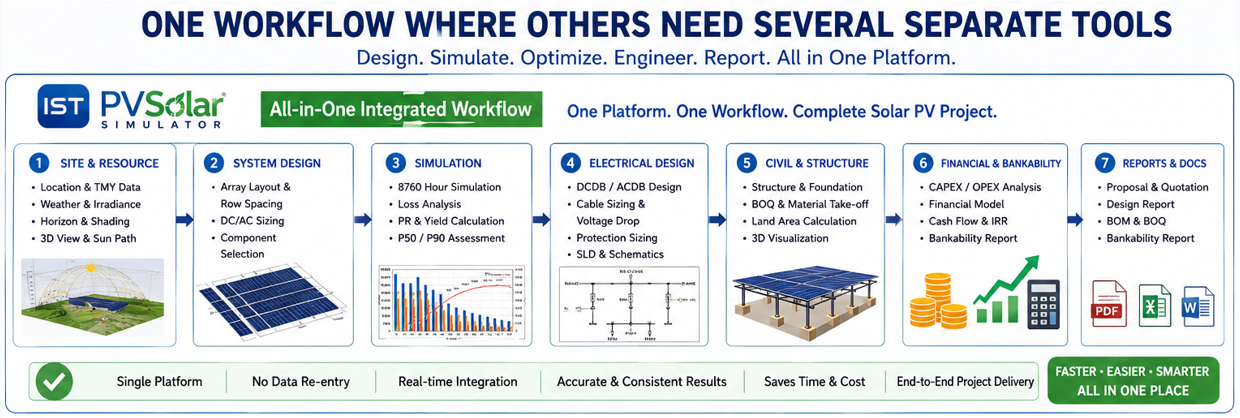
4. One workflow where others need several separate tools
Ask most teams what their actual project workflow looks like today, and it's rarely one piece of software — it's a yield simulator, plus a separate electrical/protection design step, plus a spreadsheet for financial modeling, plus a manually assembled DPR document at the end. Each hand-off between those tools is a place where numbers can drift, get copied incorrectly, or fall out of sync when a design assumption changes upstream.
IST PVSolar Simulator's distinct claim isn't that any single stage is impossible to do elsewhere — it's that yield simulation, electrical/protection design, compliance checking, and bankability reporting live in one continuous workflow, so a change made in the design stage is the same change reflected in the final lender-facing report, with no manual re-entry step in between.
A fair note on "only available here"
Everything above is a genuine, real difference in how the platform is built and what it targets — the specific combination of India-first compliance content, DPR-native reporting, and a single connected workflow is not something general-purpose international tools are built around. That said, the solar software space moves fast: individual features get added across the industry over time, and we'd rather be precise about what's distinctive today than make a permanent claim that ages badly. If you're evaluating this against another tool for a specific project, the fair test is simple — check whether your project's compliance, reporting, and design steps happen in one place or several, and how much manual reconciliation that requires either way.