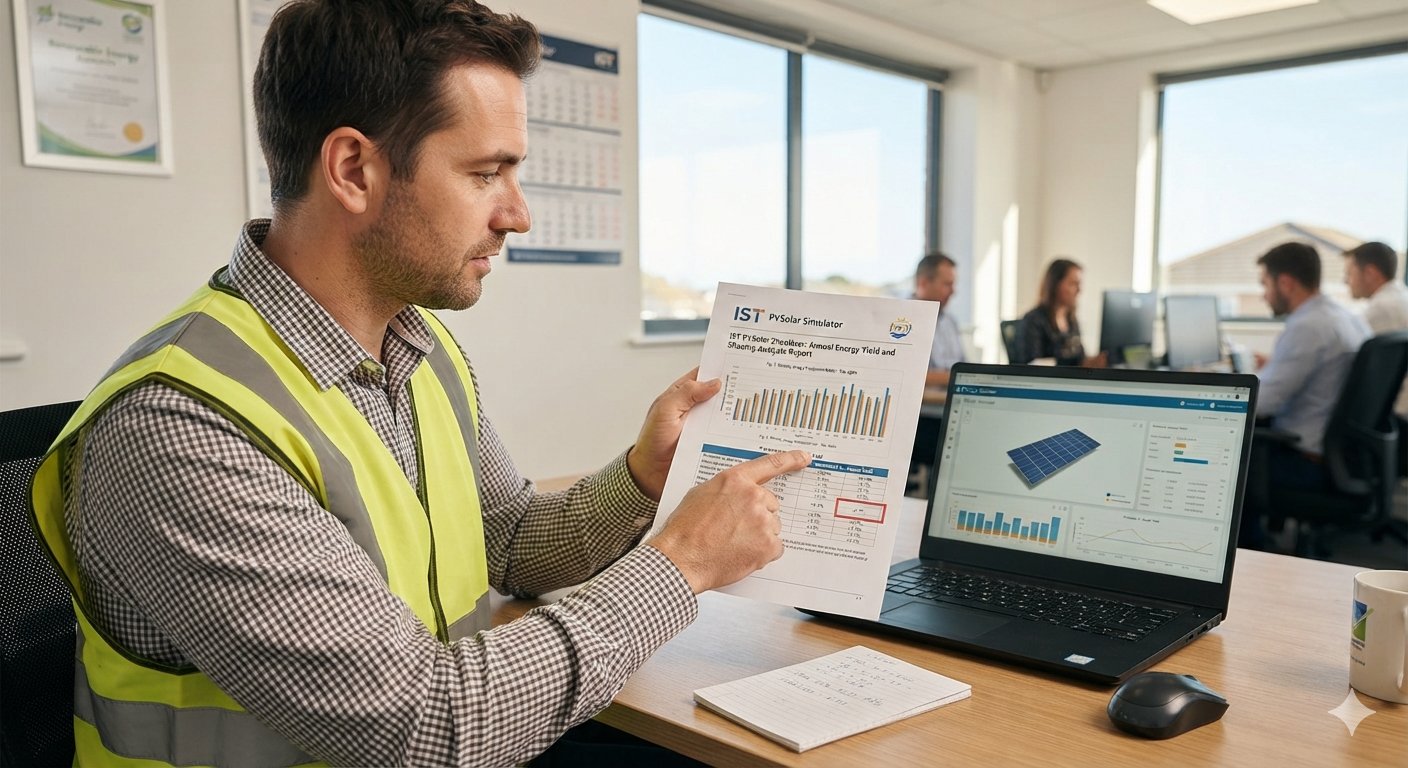
Documents and the Validation Behind Them: Why Every PDF from IST PVSolar Simulator Actually Means Something
A solar report is only as good as the checks that happened before it was printed. Anyone can generate a polished PDF with impressive-looking numbers — the harder, less visible work is making sure every figure on that page actually traces back to a validated calculation, a real standard, or a checked input. That's the part of IST PVSolar Simulator that doesn't show up in a screenshot, but shows up the moment a lender, an independent engineer, or a DISCOM official starts asking questions.
The Design Report: Built From Standards, Not Just a Template
The multi-page project report isn't a document that gets assembled from whatever numbers happen to be sitting in memory — every section maps back to a specific standard your reviewers will be checking against:
- IEC 61724-1 governs how performance is monitored and reported, which is why PR, specific yield, and energy figures follow its methodology rather than an informal calculation.
- IEC 61853 underpins the module performance modeling — irradiance and temperature dependence, not a flat STC number extrapolated linearly.
- BIS IS 16169, CEA guidelines, and MNRE technical standards shape everything from grid-code compliance sections to the declarations page that closes the report.
The report explicitly states which standards it follows on its own declaration page — not as a marketing line, but as a statement the engineer signing it is accountable for.
Numbers That Match What Was Actually Simulated
Every figure in the report — monthly POA irradiance, monthly and annual energy, performance ratio, specific yield, the P10/P50/P75/P90/P95 probability table — comes directly from the hourly or sub-hourly simulation that ran on the same inputs you configured on first to last steps. There's no separate "reporting layer" that recomputes a simplified version of the numbers for display purposes. What you see in the PDF is what the physics engine produced.
That matters because the moment a report has to reconcile two different sets of numbers from two different calculation paths, it stops being defensible. This report has exactly one source of truth.
Bankability Report: Validated Against Lender Benchmarks, Not Opinion
The bankability assessment doesn't just describe your project — it scores it against the specific thresholds a lending due-diligence team actually applies:
- Module efficiency below 20%, temperature coefficient worse than -0.35%/°C, degradation above 0.55%/yr — each flagged at the exact threshold banks use, not a rounded approximation.
- Inverter OEM Tier-1 status, product maturity years, warranty term against the 15–20 year debt-tenor benchmark.
- EPC contract structure (fixed-price vs. cost-plus), performance ratio guarantee level, delay liquidated damages cap, defects liability period — each independently classified as Low/Medium/High risk with the specific benchmark it was measured against stated in plain language.
- Legal and country risk: offtaker credit rating parsed against investment-grade rating bands, payment security mechanism type, land title status, sovereign risk rating.
Every risk flag in the report carries the reason it was raised — not just a red/amber/green badge, but the specific number and the specific benchmark it fell short of. That's the difference between a checklist and an actual due-diligence tool: a reviewer can trace every "High Risk" label back to the exact figure that triggered it.
Single Line Diagrams and Wiring Schedules: Generated, Not Drawn From Memory
The SLD and wiring diagram aren't static templates with your project name dropped in — they're built from the actual electrical solution computed for your specific module, inverter, string configuration, and cable routing. Voltage drop checks, MPPT current limits, and inverter DC voltage windows are all validated against the selected equipment's real datasheet parameters before the diagram is drawn, so what's on the page is the design that actually passed the electrical checks, not an idealized version of it.
For larger plants (≥1000 kW), the report extends to grid interconnection and LT panel busbar diagrams — the documents an independent engineer expects to see before signing off on financial close, generated from the same validated equipment schedule as everything else in the report.
Input Validation Happens Before Generation, Not After
Documents are only as trustworthy as the inputs that produced them, which is why the validation layer sits upstream of report generation, not downstream:
- Server-side plan enforcement checks that a bankability or research report is actually included in your subscription tier before the computation runs at all — not just hidden from the UI.
- Uploaded project and site-data files are validated against an allowed schema and filename pattern before their contents are trusted, so a corrupted or malformed file can't silently produce a broken report.
- Numeric inputs — tilt, azimuth, latitude, cable lengths, financial parameters — are range-checked and bounded before they ever reach the simulation engine, so a typo doesn't propagate into a nonsensical energy yield that then gets printed as fact.
Why This Matters More Than the Design
A polished PDF is easy to produce. A PDF that survives contact with an independent engineer, a lender's technical advisor, or a DISCOM reviewer is not — because every one of those readers is trained to find the gap between what a report claims and what actually supports it. The value of IST PVSolar Simulator's documents isn't the layout. It's that every number, every risk flag, and every diagram traces back through a validated calculation to a real input and a real standard — so when someone asks "how did you get this number," the answer is always traceable, never "trust us."
Conclusion
Reports don't close financing. Defensible reports do. By tying every document back to IEC/BIS/CEA/MNRE standards, validating inputs before they ever reach the simulation engine, and generating diagrams and financial figures directly from the same calculation the rest of the app relies on, IST PVSolar Simulator makes sure the paperwork you hand a lender or an EPC client is exactly as solid as the engineering behind it.