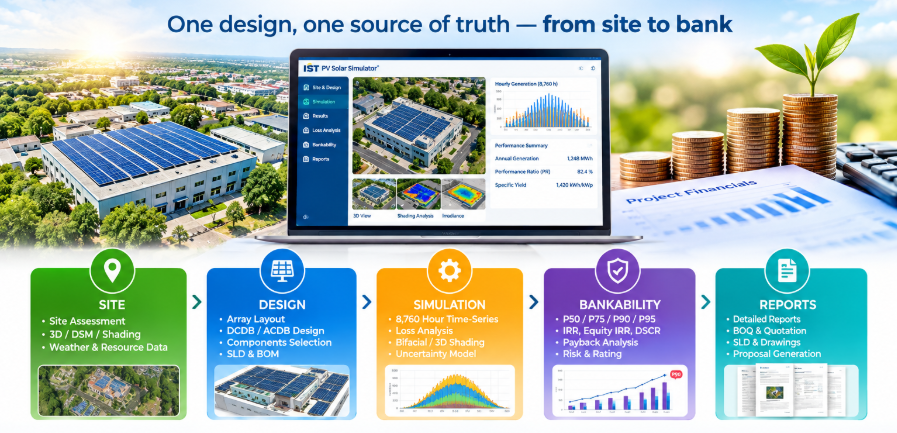
One design, one source of truth — from site to bank
IST PVSolar Simulator takes a solar project from a pin on the map to a lender-ready P90 bankability report in one browser-based platform. No exporting layouts to one tool, energy yield to another and cash flows to a spreadsheet — every number flows forward from the same design.
That matters because most solar project delays are not engineering failures. They are consistency failures: a BOQ that no longer matches the SLD, a quotation priced on last week's inverter, or a financial model built on a P50 the lender never accepted. IST PVSolar Simulator removes those gaps by design. Change the module, and the strings, SLD, BOQ, quotation, cash flow and P90 all update together.
Built for EPC contractors, developers, consultants and lenders, the platform combines bankable physics — hourly 8,760 simulation, pvlib-grade bifacial modelling, single- and two-diode module models — with the commercial outputs a project actually needs to close.
The complete workflow in 13 steps
Each step feeds the next automatically, so the bankability report at the end is built on exactly the design your team engineered at the start.
- Site Assessment. Select the site on a map and pull the solar resource from NASA POWER hourly data or PVGIS. Far-horizon profiles are ray-cast from Copernicus DEM terrain, and nearby buildings are imported from open building footprint data.
- PV Layout. Define sub-arrays, tilt, azimuth and row pitch, with row-spacing optimisation for fixed-tilt and single-axis trackers (SAT). Ground coverage ratio and inter-row losses are calculated, not assumed.
- 3D Shading. A full 3D shadow analysis models obstacles, buildings and terrain across every hour of the year. Electrical shading links partial shade to bypass-diode and string behaviour, not just irradiance loss.
- Module & Inverter Selection. Choose from the built-in library or upload a manufacturer datasheet PDF — the parser extracts electrical parameters automatically. Modules are modelled with De Soto single-diode or two-diode equations and IV curves you can inspect.
- 8,760-Hour Simulation. The hourly engine computes solar position, transposes irradiance (Perez or Hay-Davies) and models bifacial gain with an infinite-sheds model ported from pvlib. Temperature (Faiman), IAM, spectral, soiling, mismatch, LID/LeTID, clipping and degradation are all applied hour by hour.
- DC/AC Design. String sizing checks cold-weather Voc and MPPT windows against the selected inverter. DC/AC ratio (ILR), fuses, SPDs, earthing, cable sizing and voltage drop are calculated per sub-array.
- SLD. The Single Line Diagram is generated directly from the design, along with the array table, protection and cable schedule, and DC and AC cable route diagrams. Plants of 1 MW AC and above also get LT panel and grid interconnection diagrams.
- BOQ. One click derives the Bill of Quantities from the selected equipment and sub-array counts — modules, inverters, mounting structure, cabling, DCDB/ACDB, earthing, monitoring and commissioning. It remains editable and exports to CSV.
- Quotation. Customer details, quotation number and project IDs combine with the CAPEX table into a client-ready EPC proposal. Because it reads the same design, the commercial offer cannot drift from the engineering.
- Financial Model. Enter tariff, escalation, O&M, debt terms, discount rate and depreciation. The model returns NPV, IRR, LCOE, payback and DSCR over the project life.
- Uncertainty. A Monte Carlo analysis combines weather variability, model uncertainty, degradation and ageing to produce a full distribution of annual yield — not a single guessed number.
- P90. From that distribution the platform reports P50, P75, P90 and P99 energy yield, and carries P90 into the debt sizing so lenders see DSCR at the downside case they actually lend against.
- Bankability Report. A structured PDF brings it all together: site and resource, system design, loss waterfall, monthly results, P50/P90, 25-year forecast, CO₂ savings, SLD, economics and Monte Carlo pages. Operating plants can be benchmarked against SCADA data aligned to IEC 61724.
Who uses it
User | What they get |
|---|---|
EPC contractors | Design, SLD, BOQ and quotation in one pass — faster bids with fewer errors |
Developers & IPPs | P50/P90 yield and a financial model ready for investment committees |
Engineering consultants | Transparent hourly physics and loss waterfalls they can defend in technical due diligence |
Banks & lenders | P90-based DSCR and Monte Carlo uncertainty in a standard bankability report |
Asset managers | SCADA benchmarking of operating plants against expected performance |
Universities & trainers | Research and publication tools on real engineering models |
To apply, visit istpvsolarsimulator.com and tell us your country, partner tier of interest and current solar business. Our team will arrange a live demo of the full workflow — from site assessment to P90 bankability report — and walk you through the partner programme.
IST PVSolar Simulator — engineer it once, bank it with confidence.